

Who Is C.G. Jung?
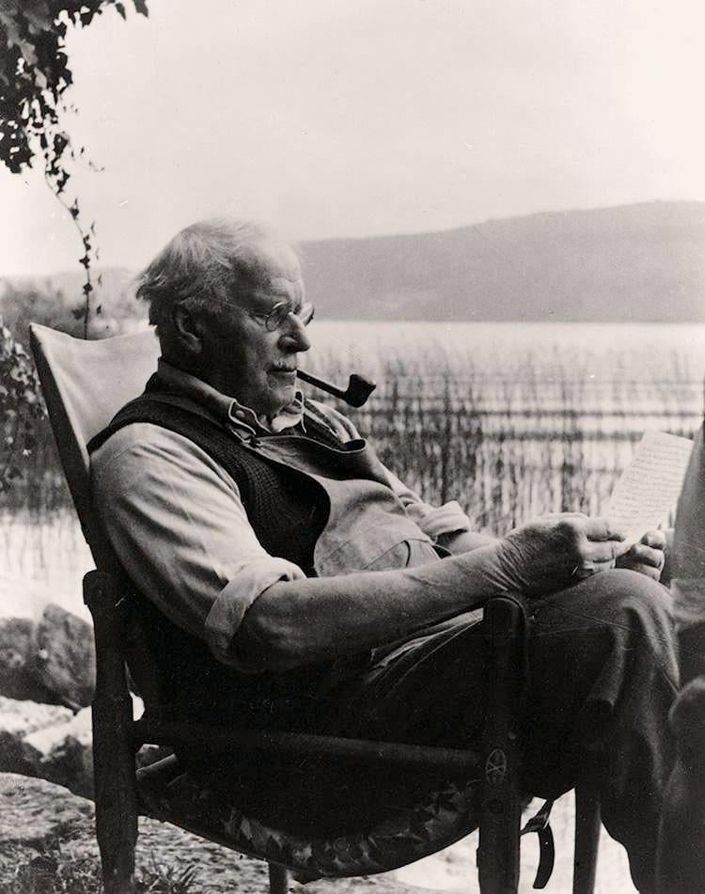
C.G. Jung was a prominent figure in the newly emerging study of the psychology of the unconscious at the beginning of the 20th century. His influence in this realm reaches far beyond his contemporaries in the field (Freud and others), though this often goes unrecognized. He was an empiricist and a dreamer, a historian and a visionary, an intellectual giant and simultaneously an enduring apprentice of the psyche.
Early in his life, Jung understood that his nature was deeply divided. This division was the cause of both his severest suffering and also his deepest joy. His divided state cleared a path for him, long and arduous, but full of the numinosum. His psychology is dialogic. His journey is a journey into wholeness. Along his path, he discovered a way to create a space within which consciousness and the unconscious could approach one another more readily and with less hostility, and he suggested a manner in which the union of these, and of all pairs of opposites, might be contained, leading to a more creative, cohesive, and meaningful life.
This he named individuation.
Jung's Contribution
Jung’s intellectual and psycho-spiritual legacy is a vital and tangible source from which a powerful and wide-reaching undercurrent flows that courses through and vivifies contemporary discourse. Concepts and terms that he brought to life while attempting to map unknown territory in the human psyche continue to find expression, efficacy, and meaning in the present day. Terms like shadow, archetype, anima/animus, psychological complex, introversion/extroversion, the collective unconscious, individuation, the Self, synchronicity, and alchemy (as a metaphor for transformation) flavor contemporary culture, anchor many personal growth models, and permeate existing and emerging spiritual disciplines.
Curriculum ~ 12 Modules Covering Fundamental Concepts in Analytical Psychology
- Introduction
- In His Own Words
- List of Biographies
- Life and Work Timeline
- Lecture Video: Section 1 - The Early Years 1875-1900 (13:29)
- Lecture Video: Section 2 - The Scholar-Physician Period 1900-1928 (26:13)
- Lecture Video: Section 3 - The Master Period 1928-1946 (12:56)
- Lecture Video: Section 4 - The Wise Old Man 1946-1961 (11:12)
- Test Your Knowledge
- Resources
- Video Lecture: Section I - Jung's Model as a Whole (18:28)
- Video Lecture: Section II - Where Did Jung's Typology Come From? Where Is It Now? Where Does It Want to Go? (10:38)
- Video Lecture: Section III - Jung's Typology & the MBTI (30:01)
- Video Lecture: Section IV - What Would Jung Say About the Current State of Affairs Regarding His Typology? (6:37)
- Video Lecture: Section V - Living Into Whole Type (26:07)
- Video Lecture: Section VI - Conclusion (4:52)
- Test Your Knowledge
- Typology Reference Material - Power Point Presentation Slides
- References
- What is the Shadow in Analytical Psychology?
- Video Lecture: Section 1 (17:55)
- Video Lecture: Section 3 (22:49)
- Video Lecture: Section 2 (11:16)
- Video Lecture: Section 4 (13:20)
- Summary of Shadow Lecture Content
- Ready to catch a glimpse of your Shadow? (downloadable worksheets)
- How to Work with Your Shadow Material...
- Test Your Knowledge
- Concluding Remarks, from C.G. Jung
- Resources
- Dreams: Nature's Portal to the Source, Section I (33:17)
- Dreams: Nature's Portal to the Source, Section II (15:52)
- Working With Your Dreams
- Tips For Remembering Your Dreams
- Dreams Lecture: Select & Related References
- Active Imagination: Jungian Dialectics and the Interior Self, Section I (23:05)
- Active Imagination: Jungian Dialectics and the Interior Self, Section II (23:29)
- Guidelines for Active Imagination
- Jung on Active Imagination
- Active Imagination: Select & Related References
- Test Your Knowledge - Dreams & Active Imagination
The following topics are embedded within the curriculum of this course, separated into 12 modules, but each module/concept may alternatively be purchased individually according to preference, in any desired sequence, through the links below.



Angelo Spoto, Course Instructor
Angelo Spoto, M.A., LMHC is a licensed mental health counselor with a Master’s degree in Analytical Psychology. He is co-founder of the C.G. Jung Library of Tampa Bay and author of Jung’s Typology in Perspective (Chiron Publications).
